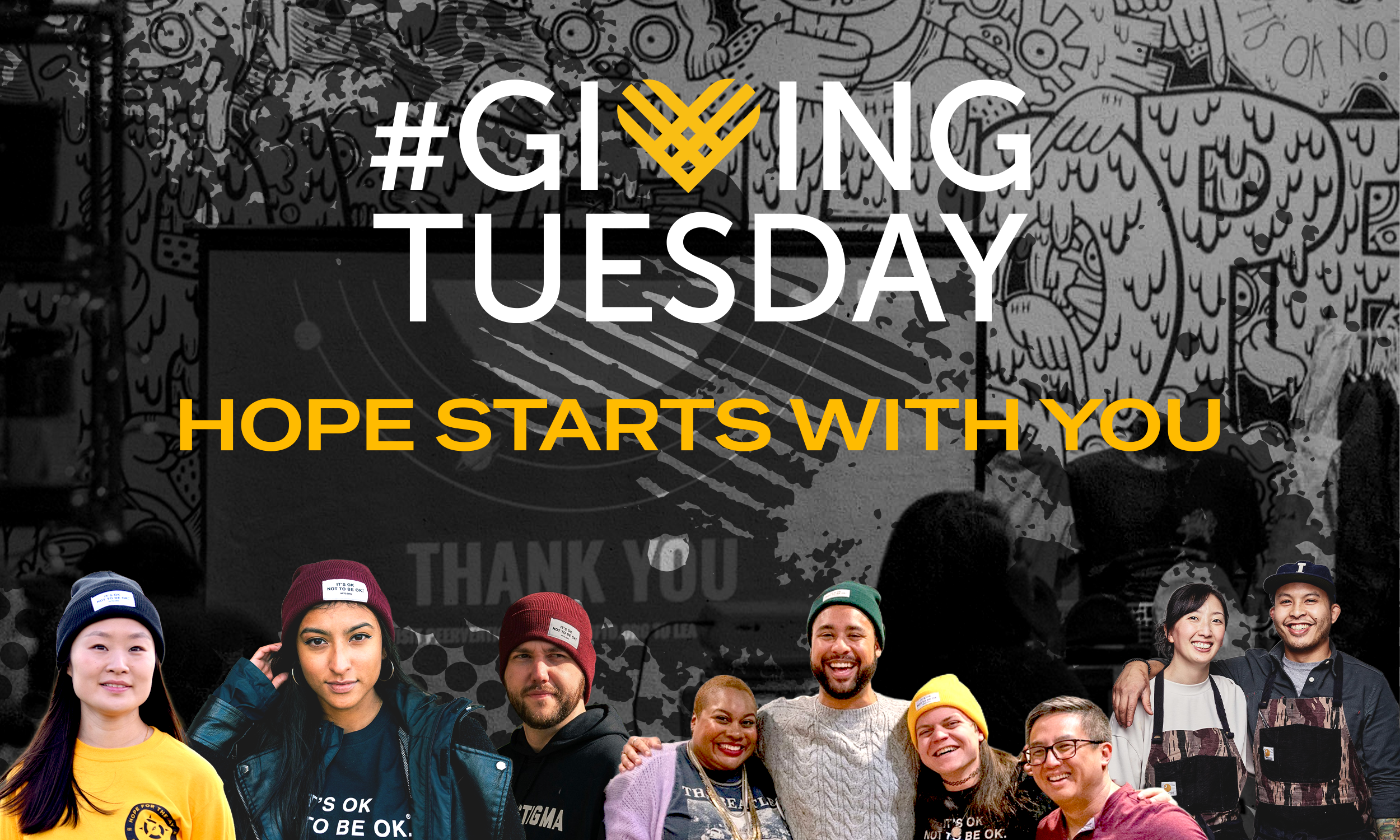
Support Proactive Suicide Prevention and Mental Health Resources this #GivingTuesday.
Suicide prevention is more than a hotline. Real impact starts with visibility — making sure every person has access to free, local mental health resources when they need them most. By raising awareness, increasing distribution of resources, and expanding proactive suicide-prevention education, we meet people where they are and empower early intervention.
This Giving Tuesday, your support helps us continue providing the tools, education, and resources our communities deserve in 2026 — from resource cards and outreach events to trainings that remind people they’re not alone.
Every conversation matters. Every action creates access. Hope starts with you.
Start a Fundraiser
Encourage your community to take action towards proactive suicide prevention by starting your own fundraiser! Individual pages can be customized to share with loved ones why the cause is important to you.
Share our Fundraiser
Sharing our fundraiser with your community creates a bigger impact than you know! Being proactive about suicide prevention often looks like starting the conversation on mental health. Sharing resources on social media is a great way to do this!

Physical Resources

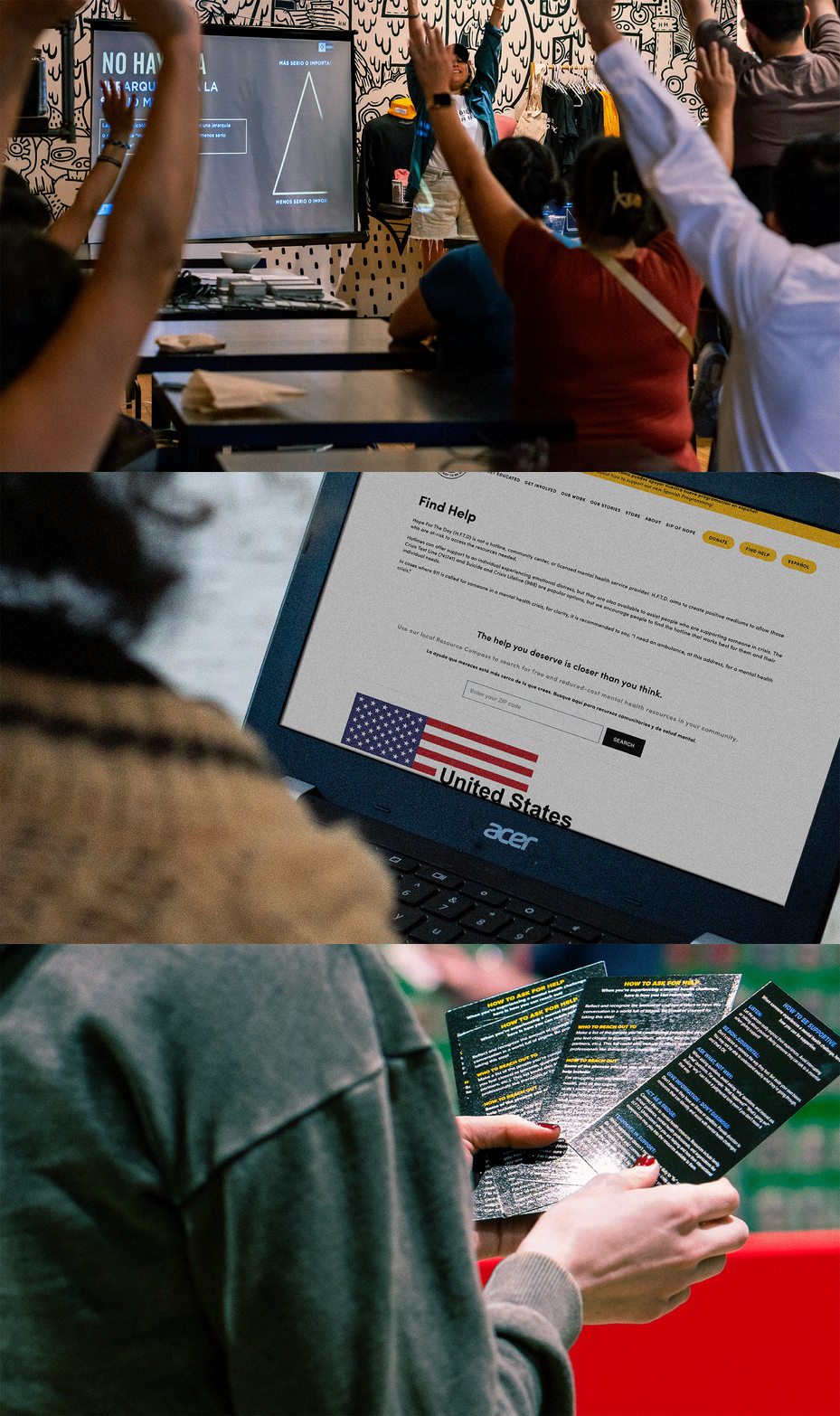
Our Physical Resources offer a tangible way for us to start the conversation in communities, especially where there are gaps in understanding mental health. Currently, we have resources to help people navigate a number of situations including, How to Ask For Help, How to Be Supportive, Understanding Non Suicidal Self Injury and Self Harm, Navigating Conversations About Suicide, and How to Support Someone Who Has Been Impacted By Suicide.
Outside of our conversation cards, we also offer resources that list hotlines and text lines, mental health guides, worksheets, and more. So far, in 2024, we have distributed over 50,000 resources in schools, workplaces, concerts, festivals, and various other community spaces. Our hope is that these resources empower and equip people to navigate difficult conversations surrounding mental health.
Education

Our clinically-backed and peer led education programming teaches individuals the tools they need to support themselves and those around them. Currently, we offer a number of education sessions, including The Things We Don't Say | Part 1, The Things We Don't Say | Part 2, The Things We Don't Say | Identity and Orientation, and our newest offering Lo Que Callamos. We also offer customized education sessions for Proactive Workplaces, as well as specialized sessions covering Topics Orbiting Suicide.
Not only do we provide live, in-person workshops both publicly and privately, but we also teach our education virtually over zoom, as well as through an easy-to-use e-learning program. So far in 2024, we’ve educated over 8,000 individuals in our mental health education programming. Our hope is that individuals will take our education sessions and leave feeling empowered to start the conversation in their own communities.
For $10 you can cover the cost of an online Mental Health Education for one individual
For $100 you can cover the cost of one mental health workshop in a community space!
Resource Compass

Suicide prevention is more than a hotline. It is no secret that our quality of life can be both positively and negatively affected by our mental health. This means that supporting someone's mental health can look like assisting with housing costs, ensuring access to quality food, or even supporting them through an educational class.
Our Find Help tool allows you to enter your zip code and be connected to resources right in your own neighborhood. So far, in 2024, we have had over 100,000 searches on our Find Help tool. Offered for completely free, we ultimately just want people to know that the help they deserve is accessible and closer than they think.
Contact us to learn more about sponsoring our Resource Compass
Join Us at Big Mini Putt Club for Giving Tuesday
Come hang with the H.F.T.D. team, play a round (or three) of mini golf, pick up merch, and connect with a community that knows the same truth: the more we talk about our mental health, the more we realize we’re not alone.
Bring friends, coworkers, or just yourself — every conversation and every donation helps expand proactive suicide-prevention education and raise the visibility of free, local resources across Chicago
Show up. Start the conversation. Hope starts with you.
Tuesday, December 2, 2025 • From 5 PM to 8 PM CT
BIG MINI PUTT CLUB (Wicker Park)
1302 N Milwaukee Ave, Chicago, IL 60622

Download or Purchase Resources:

General Resource Cards
from $5.00
Pack of our 4x4 General Resource Cards printed for distribution or display. These cards contain the following information:
DESPITE THE THINGS YOU’VE BEEN THROUGH, IT’S OK NOT TO BE OK.
Hope for the Day (HFTD) is a non-profit movement empowering the conversation on proactive suicide prevention and mental health education.
NATIONAL SUICIDE PREVENTION LIFELINE (800) 273-TALK(8255) *Now known as THE 988 LIFELINE - 988
CRISIS TEXT LINE – TEXT ‘ITSOK’ TO 741741
SUBSTANCE ABUSE & MENTAL HEALTH SERVICES – (800) 662-HELP(4357)
NATIONAL SEXUAL ASSUALT HOTLINE – (800) 656-HOPE(4673)
FOR VETERANS – CALL (800) 273-8255 (PRESS 1) OR TEXT: 838255
TRANS LIFELINE – (877) 565-8860
THE TREVOR PROJECT FOR LGBTQ+ YOUTH – (866) 488-7386
NATIONAL MATERNAL MENTAL HEALTH HOTLINE – (833) TLC-MAMA (852-6262)
QR CODE TO HFTD’S RESOURCE COMPASS LOCATED AT HFTD.ORG/FIND-HELP
FOR MORE RESOURCES, VISIT HFTD.ORG
If you are purchasing resource cards for a school or business, please fill out our contact form so we can assist you further.

LGBTQ+ Resource Cards
from $5.00
Pack of our 4x4 LGBTQ+ Resource Cards printed for distribution or display. These cards contain the following information:
DESPITE THE THINGS YOU’VE BEEN THROUGH, IT’S OK NOT TO BE OK.
Hope for the Day (HFTD) is a non-profit movement empowering the conversation on proactive suicide prevention and mental health education.
THE TREVOR PROJECT FOR LGBTQ+ YOUTH - (866) 488-7386
TRANS LIFELINE - (877) 565-8860
SAGE - ELDER HOTLINE - (877) 360-5428
NATIONAL SEXUAL ASSUALT HOTLINE - (800) 656-HOPE(4673)
CRISIS TEXT LINE - TEXT ‘ITSOK’ TO 741741
SUBSTANCE ABUSE & MENTAL HEALTH SERVICES - 1-800-662-HELP(4357)
FOR VETERANS - CALL (800) 273-8255 (PRESS 1) OR TEXT: 838255
QR CODE TO HFTD’S RESOURCE COMPASS LOCATED AT HFTD.ORG/FIND-HELP
FOR MORE RESOURCES, VISIT HFTD.ORG
If you are purchasing resource cards for a school or business, please fill out our contact form so we can assist you further.
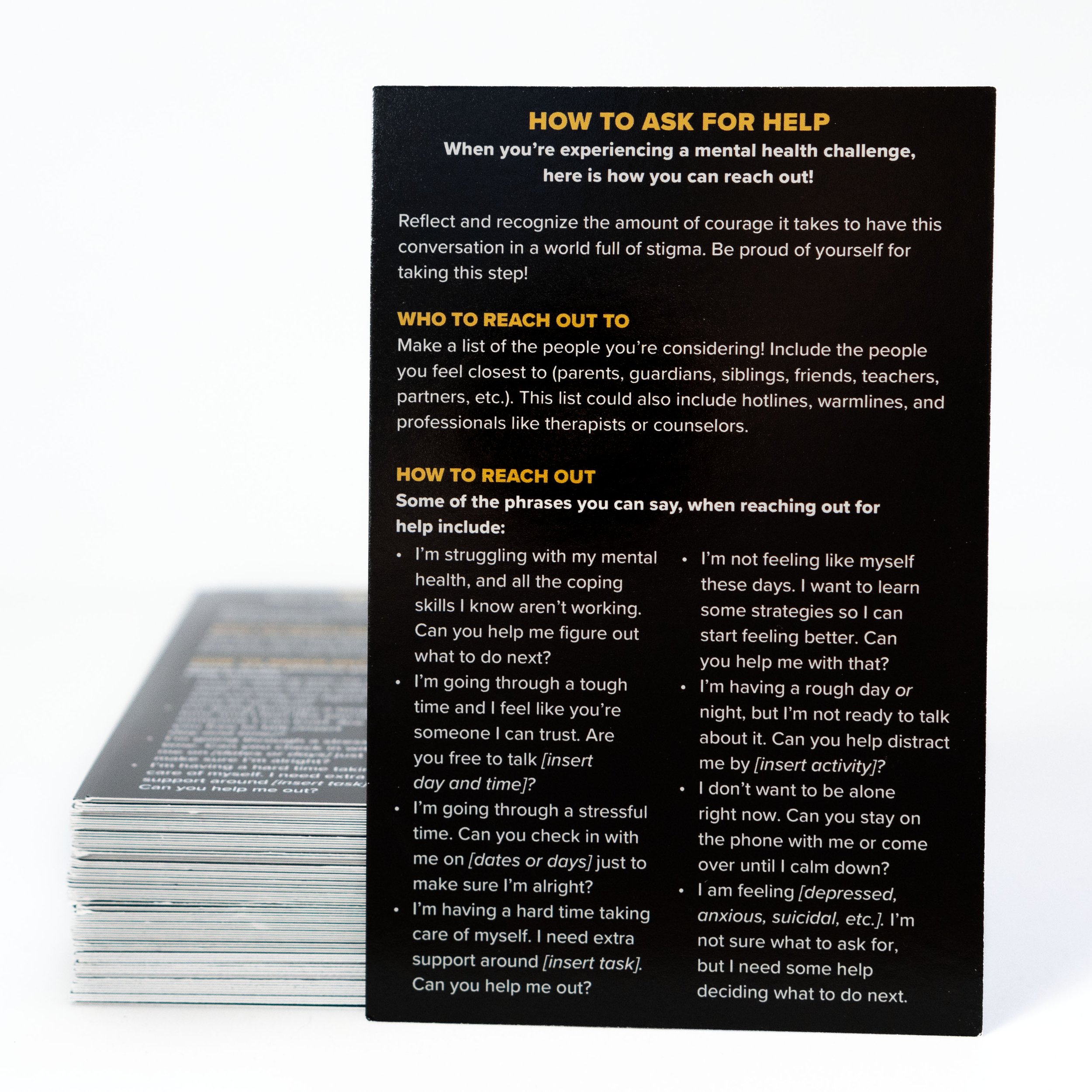
"How to Ask for Help" Conversation Cards
from $5.00
Pack of our 4×6 How to Ask for Help Conversation Cards printed for distribution or display. These cards contain the following information:
HOW TO ASK FOR HELP
When you’re experiencing a mental health challenge, here is how you can reach out!
Reflect and recognize the amount of courage it takes to have this conversation in a world full of stigma. Be proud of yourself for taking this step!
WHO TO ASK: Make a list of the people you’re considering! Include the people you feel closest to (parents, guardians, siblings, friends, teachers, partners, etc.). This list could also include hotlines, warmlines, and professionals like therapists or counselors.
HOW TO ASK: Some of the phrases you can say, when reaching out for help include:
I’m struggling with my mental health, and all the coping skills I know aren’t working. Can you help me figure out what to do next?
I’m going through a tough time and I feel like you’re someone I can trust. Are you free to talk [insert day and time]?
I’m going through a stressful time. Can you check in with me on [dates or days] just to make sure I’m alright?
I’m having a hard time taking care of myself. I need extra support around [insert task]. Can you help me out?
I’m not feeling like myself these days. I want to learn some strategies so I can start feeling better. Can you help me with that?
I’m having a rough day or night, but I’m not ready to talk about it. Can you help distract me by [insert activity]?
I don’t want to be alone right now. Can you stay on the phone with me or come over until I calm down?
I am feeling [depressed, anxious, suicidal, etc.]. I’m not sure what to ask for, but I need some help deciding what to do next.
OTHER RESOURCES: Hope For The Day’s Resource Compass is a tool that allows us to search any US Zip Code for a variety of social services in the area, including free & sliding-scale resources for mental health.
You can also access any of these lifelines! Many of them are 24 hours, including the National Suicide Prevention Lifeline and the Crisis Text Line—where you can text with a trained crisis counselor.
If you are purchasing resource cards for a school or business, please fill out our contact form so we can assist you further.

"How To Be Supportive" Conversation Cards
$0.00
Pack of our 4x6 How To Be Supportive Double Sided Quick Cards printed for distribution or display. These cards contain the following information:
HOW TO BE SUPPORTIVE
When someone experiences a mental health challenge, here is how you can be supportive.
LISTEN:
Let the person really express their experiences. Avoid interrupting or talking about yourself. Being someone they can talk to is essential when giving support!
BE NON-JUDGMENTAL:
Don’t criticize or minimize the way they feel. Set aside your own biases. You may not be able to understand exactly what they’re going through, and that’s OK.
ASK WHAT, NOT WHY:
When asking questions, avoid asking ‘why’ questions, and instead ask ‘what’ questions. For example: “What happened?” “What’s going on?” Asking “why” can have a judgmental tone even if you don’t mean it that way.
GIVE INFORMATION - DON’T DIAGNOSE:
Don’t assume they have an illness or condition. Provide direction to resources that can identify and assist with mental health challenges.
ACT AS A BRIDGE:
Connect them to mental health resources. Resources include family, school guidance, mental health professionals, and organizations like H.F.T.D. Understand who you are helping and how their intersectional experiences may play into the resources available to them.
TEAMMATE IN SUPPORT:
Being supportive doesn’t mean it is your duty to “fix” someone. Be clear about and communicate your own limits and limitations. Avoid making promises like, “I’m available to you 24 hours a day. Call me any time, and I’ll be there for you,” because there are times when you are not available (and that’s okay), just be clear in your communication and be able to offer alternatives, like another friend, or a lifeline.
BE YOURSELF!
While keeping everything else in mind — the most important thing is that you be natural. You don’t want to estrange the other person by seeming rigid or like you’re going through a list. As long as you avoid stigmatizing or judgmental phrasings, engage in the conversation the way that feels right.
HELPFUL PHRASES:
It sounds like what you were experiencing felt intolerable and overwhelming.
I want to understand what you were experiencing/feeling.
I want to help you. Tell me what I can do to help.
You don’t have to talk if you don’t want to, but I can and want to listen.
I can tell something is wrong and that you are hurting. I’m here for you.
LEARN EVEN MORE:
Check out hftd.org/geteducated to learn even more about mental health education and proactive suicide prevention.
Hope for the Day® (H.F.T.D.) is a non-profit movement empowering the conversation on proactive suicide prevention and mental health education.
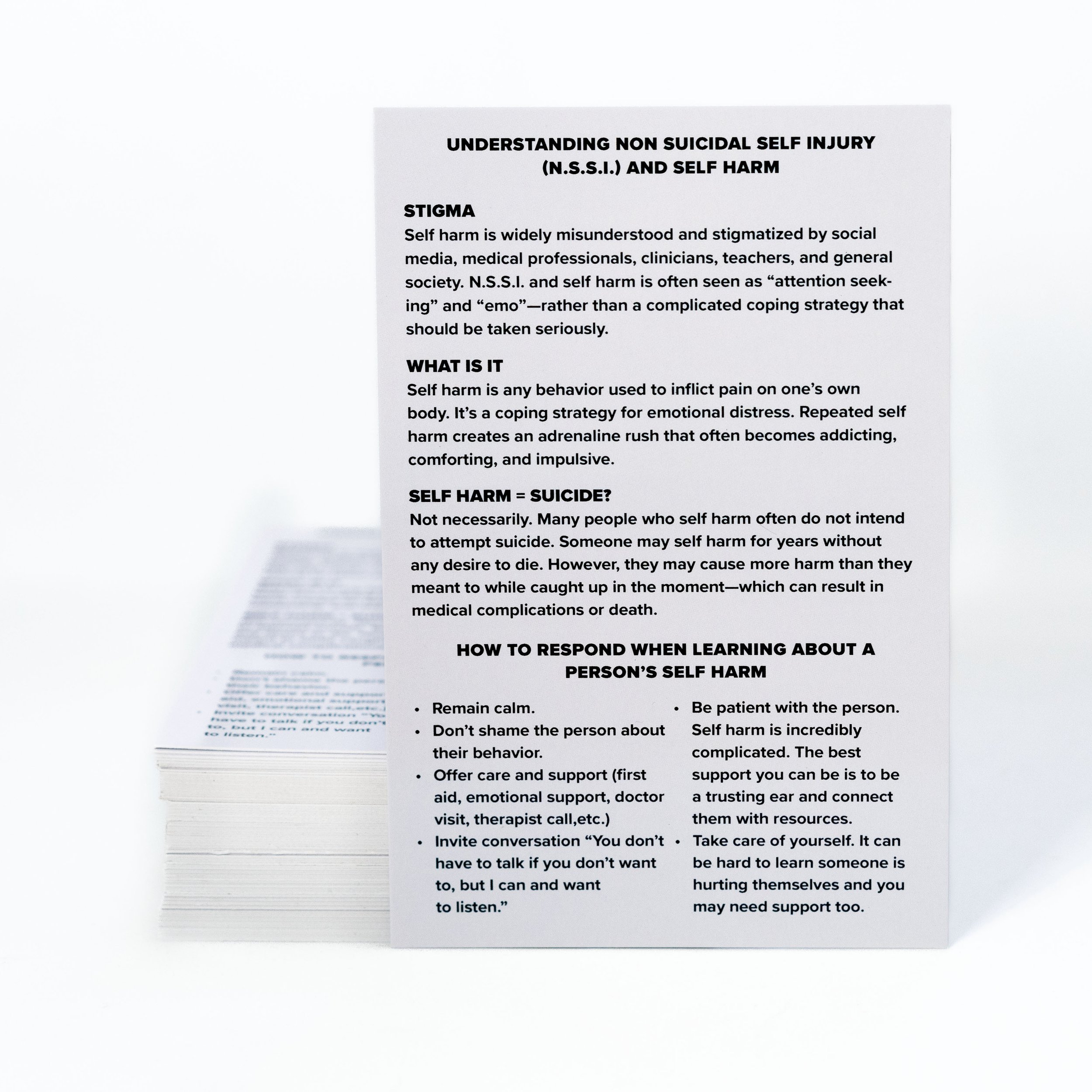
"Understanding Non Suicidal Self Injury (N.S.S.I.) Quick Card" Conversation Cards
from $5.00
Pack of our 4x6 Understanding Non Suicidal Self Injury (N.S.S.I.) Quick CardQuick Cards printed for distribution or display. These cards contain the following information:
Pack of our 4x6 Understanding Non Suicidal Self Injury (N.S.S.I.) Double Sided Quick Cards printed for distribution or display. These cards contain the following information:
UNDERSTANDING NON SUICIDAL SELF INJURY (N.S.S.I.) AND SELF HARM
STIGMA
Self harm is widely misunderstood and stigmatized by social media, medical professionals, clinicians, teachers, and general society. N.S.S.I. and self harm is often seen as “attention seeking” and “emo”—rather than a complicated coping strategy that should be taken seriously.
WHAT IS IT
Self harm is any behavior used to inflict pain on one’s own body. It’s a coping strategy for emotional distress. Repeated self harm creates an adrenaline rush that often becomes addicting, comforting, and impulsive.
SELF HARM = SUICIDE?
Not necessarily. Many people who self harm often do not intend to attempt suicide. Someone may self harm for years without any desire to die. However, they may cause more harm than they meant to while caught up in the moment—which can result in medical complications or death.
HOW TO RESPOND WHEN LEARNING ABOUT A PERSON’S SELF HARM
Remain calm.
Don’t shame the person about their behavior.
Offer care and support (first aid, emotional support, doctor visit, therapist call, etc.)
Invite conversation “You don’t have to talk if you don’t want to, but I can and want to listen.”
Be patient with the person. Self harm is incredibly complicated. The best support you can be is to be a trusting ear and connect them with resources.
Take care of yourself. It can be hard to learn someone is hurting themselves and you may need support too.
HOW TO RESPOND WHEN LEARNING ABOUT A PERSON’S SELF HARM
Encourage them to work with a therapist.
Explore swapping out this behavior for another less harmful coping strategy. (holding an ice cube, etc.)
Offer resources specific to self harm and recovery!
Continue to be patient as your person continues on their recovery journey. (Do not police their recovery.)
OTHER RESOURCES
You can access the Hope For The Day® Resource Compass at HFTD.ORG/FIND-HELP. The Resource Compass is a tool that allows us to search any US Zip Code for a variety of social services in the area, including free & sliding-scale resources for mental health.
You can also access any of these lifelines! Many of them are 24 hours, including the 988 Suicide and Crisis Lifeline and the Crisis Text Line—where you can text with a trained crisis counselor.
NATIONAL SUICIDE PREVENTION LIFELINE (800) 273-TALK(8255) *Now known as THE 988 LIFELINE - 988
CRISIS TEXT LINE - TEXT ‘ITSOK’ TO 741741
SUBSTANCE ABUSE & MENTAL HEALTH SERVICES - 1-800-662-HELP(4357)
NATIONAL SEXUAL ASSUALT HOTLINE - (800) 656-HOPE(4673)
FOR VETERANS - CALL (800) 273-8255 (PRESS 1) OR TEXT: 838255
TRANS LIFELINE - (877) 565-8860
THE TREVOR PROJECT FOR LGBTQ+ YOUTH - (866) 488-7386
QR CODE TO HFTD’S RESOURCE COMPASS LOCATED AT HFTD.ORG/FIND-HELP
Hope for the Day® (HFTD) is a non-profit movement empowering the conversation on proactive suicide prevention and mental health education.
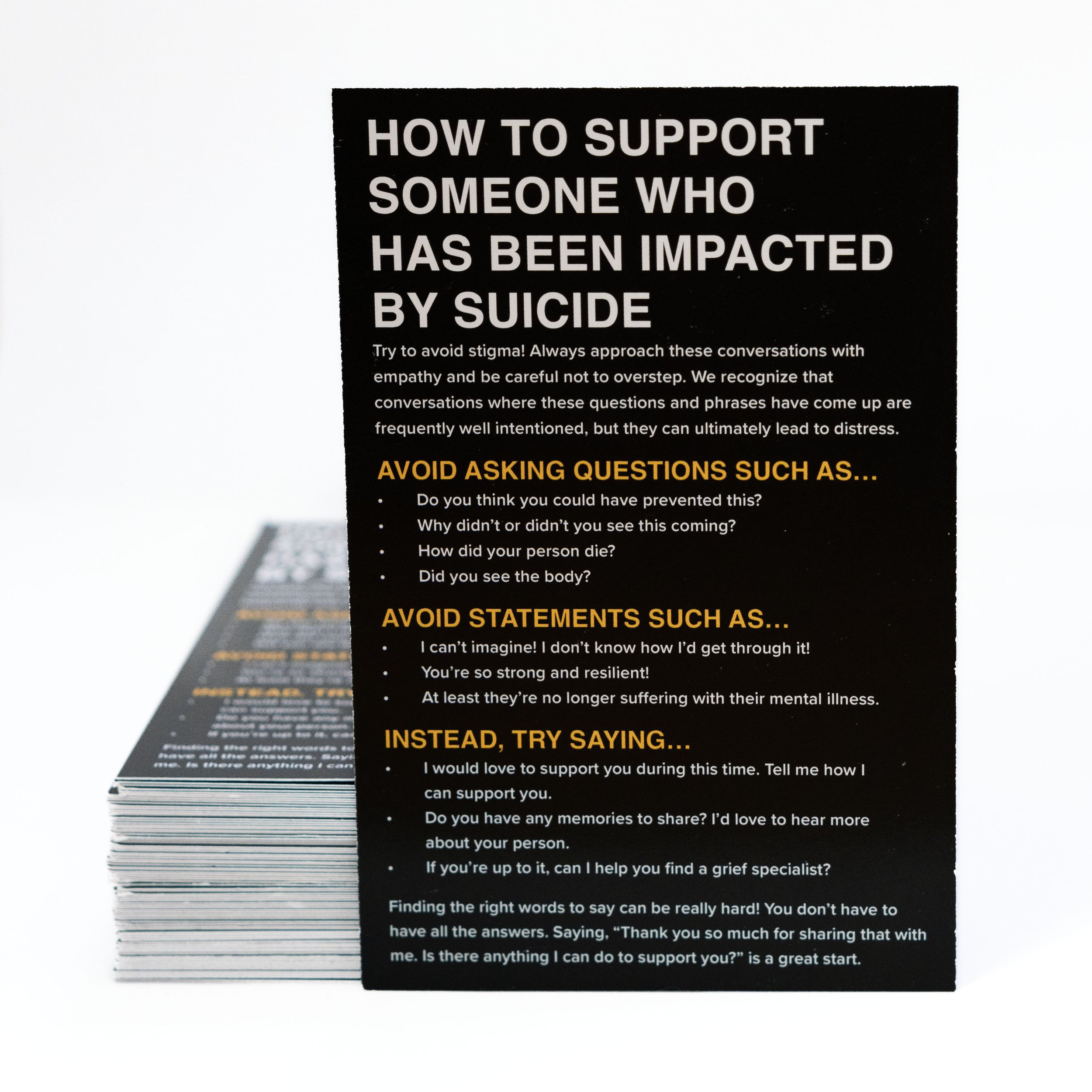
"How to Support Someone Who Has Been Impacted By Suicide" Conversation Card
from $5.00
Pack of our 4x6 "How to Support Someone Who Has Been Impacted By Suicide" Double Sided Quick Cards printed for distribution or display. These cards contain the following information:
Why do we talk about suicide?
Suicide and thoughts of suicide are part of the overall mental health spectrum—regardless of if someone has a clinical diagnosis or not.
Talking about suicide does not cause suicide. Creating a space where people feel safe to talk about their experiences fosters supportive communities. People are more likely to seek support and resources, and determine the best way to heal and manage their challenges!
What do we say about suicide?
Due to stigma, conversations about suicide typically happen after a crisis. Proactive suicide prevention encourages conversations about suicide to happen BEFORE the crisis stage. This disrupts the risk factors for suicide by breaking the silence as a community and normalizing mental health.
How do we talk about suicide?
Language is important. The ways we choose to talk about suicide matter so that we are not creating further stigma in communities. The most important thing to remember is that suicide is not something that should be criminalized, so we completely avoid the phrase “committed suicide.” Instead, opt for other options such as “ “died by suicide,” or “lost their life to suicide.”
Find Help
Hotlines can offer support to an individual experiencing emotional distress, but they are also available to assist people who are supporting someone in crisis. The Crisis Text Line (741741) and Suicide and Crisis Lifeline (988) are popular options, but we encourage people to find the hotline that works best for them and their individual needs.
In cases where 911 is called for someone in a mental health crisis, for clarity, it is recommended to say, "I need an ambulance, at this address, for a mental health crisis."
If you are purchasing resource cards for a school or business, please fill out our contact form so we can assist you further.

Spanish Resource Cards
from $5.00
Pack of our 4x4 Spanish Resource Cards printed for distribution or display.
These hotlines are equipped to assist folks in Spanish. Want even more Spanish? Visit HFTD.ORG/ES
These cards contain the following information:
ESTA BIEN NO ESTAR BIEN!
A PESAR DE LAS COSAS POR LAS QUE HAS PASADO, ESTA BIEN NO ESTAR BIEN!
Hope For The Day® (H.F.T.D.) es un movimiento sin fines de lucro que empodera la conversación sobre la prevención proactiva del suicidio y la educación en la salud mental.
LA LÍNEA 988 DE PREVENCIÓN DEL SUICIDIO Y CRISIS:
LLAME O MANDE TEXTO CON LA PALABRA “AYUDA” AL NÚMERO: 988
LA LÍNEA DE AYUDA NACIONAL DE ABUSO SEXUAL:
(800) 656-HOPE (4673) *OPRIMA #2
LÍNEA DE VIDA TRANS:
(877) 565-8860 *OPRIMA #2
LÍNEA DE TEXTO PARA CRISIS:
LLAME O MANDE TEXTO CON LA PALABRA "AYUDA" AL NÚMERO: 741741
LÍNEA NACIONAL DE SALUD MENTAL MATERNA:
LLAME O MANDE TEXTO: (833) TLC-MAMA (852-6262)
LA LÍNEA DE AYUDA NACIONAL DE VIOLENCIA DOMÉSTICA:
(800) 799-SAFE (7233) O MANDE TEXTO CON LA PALABRA “START” AL 88788
SAGE LÍNEA DE AYUDA PARA LAS PERSONAS MAYORES LGBTQ+:
(877) 360-5428
If you are purchasing resource cards for a school or business, please fill out our contact form so we can assist you further.


IT'S OK NOT TO BE OK Wristband Multi Packs
from $5.00
Black Signature Rubber It’s Ok Not To Be Ok wristbands available in packs of 5, 25, 100, 250, 500.